Make a Donation
Give to a qualified scholarship granting organization (SGO).
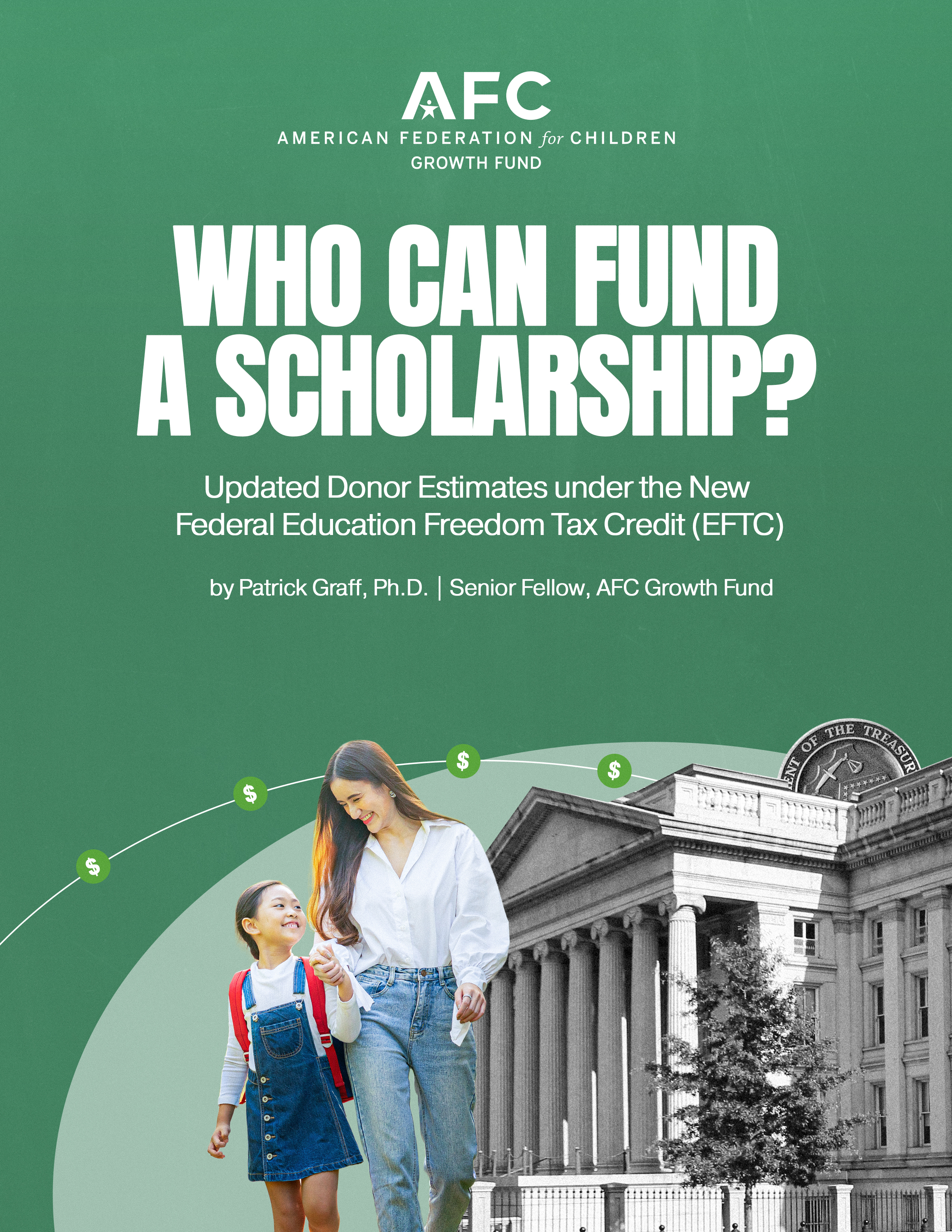
Updated Donor Estimates under the New Federal Education Freedom Tax Credit (EFTC)
Treasury's proposed rules for the Education Freedom Tax Credit (EFTC) let each spouse on a joint return claim $1,700, ending the marriage penalty. At 10% participation, that adds $7.5 billion a year, enough for more than 1 million additional scholarships at an average of $7,000, or more than 2 million at an average of $3,500.
If one in ten eligible donors participates, the EFTC would fund about 7 million scholarships a year at an average of $3,500, or about 3.5 million at $7,000. The $26.3 billion in annual giving behind those scholarships matches Treasury's projection of $26 billion a year at 10% take-up.
An estimated 121.5 million tax returns, nearly three in four filers (74.2%), will owe federal income tax and be eligible to claim the EFTC in tax year 2027. Because each spouse on a joint return can give $1,700, that comes to 172.0 million taxpayers who can donate to a scholarship granting organization (SGO).
Of the 50.5 million married couples filing jointly who owe federal income tax, 42.2 million (83.7%) owe at least $3,400 and can claim the full joint credit.If couples give at the same rate as other filers, the $3,400 credit adds $3.8 billion a year for every five percentage point increase in donor participation.
Of the 121.5 million tax returns that owe federal income tax, 96.5 million (79.4%) owe enough to claim the full credit: $1,700, or $3,400 for married couples filing jointly.Another 25.0 million can claim a credit up to their full liability.
The 31 states that have opted in or signaled intent to opt in as of October are home to 68.3 million eligible donors and $147.1 billion in giving capacity (56% of the national total). At 10% participation, these donors alone could fund 2.1 to 4.2 million scholarships a year The 20 jurisdictions yet to decide hold 53.2 million eligible donors, but their 20.8 million eligible students cannot receive a scholarship until their state opts in. Donors in those states can still give to an SGO in any participating state.
Treasury's proposed rules count after-tax payroll deductions as a qualifying contribution, so donors do not need to front the gift and wait for tax season. A married couple can give the full $3,400 for about $131 per biweekly paycheck (about $283 a month), and a single filer can give $1,700 for about $65. Employer facilitated payroll deduction systems can also help an employee reduce their W-4 withholding by the same amount in anticipation of receiving the tax credit, which then leaves bi-weekly take-home pay unchanged.
Payroll giving spreads a gift across the year, and married couples can now give twice as much per return. Our modeling finds that, together, these changes could more than double the number of students served as donor participation in the EFTC scales over time.
How many tax credits can be claimed for donations to scholarship granting organizations through the Education Freedom Tax Credit? Choose a jurisdiction and a scenario.
Open Advanced Details to load scenario presets or vary participation across full- and partial-credit taxpayers.
One rate applied to all eligible taxpayers. Open Advanced Details for scenario presets or separate full- and partial-credit rates.
Each preset sets separate rates for full-credit and partial-credit taxpayers.
The two sliders move independently: assume, say, partial-credit taxpayers at 2% while full-credit taxpayers give at 10%.
Each gift = the smaller of $1,700 per taxpayer ($3,400 for a married couple filing jointly) and the federal tax bill; at 100% participation this reproduces the $263.0B total capacity in AFC’s October 2026 update for Treasury’s proposed rules.
| Full-credit taxpayers giving × average gift | = | $0 |
| Partial-credit taxpayers giving × average gift | = | $0 |
| Total raised | = | $0 |
Group figures are rounded for display.
Taxpayers vs. tax filers. This calculator counts taxpayers: each spouse on a joint return is one taxpayer. Tax filers (tax returns) count a married couple filing jointly once, so the 172.0 million eligible taxpayers file 121.5 million tax returns. Treasury’s analysis of the proposed rules projects that more than 11 million taxpayers would give $26 billion a year at 10 percent take-up. That count is close to the 12.2 million tax returns behind this calculator’s 10 percent scenario rather than its 17.2 million taxpayers, while the dollars raised are almost exactly the same: $26.3 billion here vs. Treasury’s $26 billion.
In every scenario, these projections assume tax filers will not give more than their federal income tax liability in the given tax year. A green ✓ marks a state that has signaled intent to or has opted in as of October 2026. Opting in governs where scholarships are funded, not who may donate.
Illustrative scenarios. Participation rates and the giving-rate assumption are user-set inputs, as is the average scholarship amount; none are AFC estimates or projections. Taxpayer counts and capacity are the certified figures from the AFC donor-capacity analysis, updated for Treasury’s proposed rules; this calculator shows potential fundraising, not a forecast and not a federal revenue estimate.
Give to a qualified scholarship granting organization (SGO).
The SGO turns donations into scholarships for students who need them.
Funds cover educational costs: tuition, tutoring, books, and more.
At filing, the donor claims a dollar-for-dollar federal credit of up to $1,700.

Patrick Graff is a Senior Fellow with the American Federation for Children. At AFC, he advises the Government Affairs team on school choice policy design and research.